
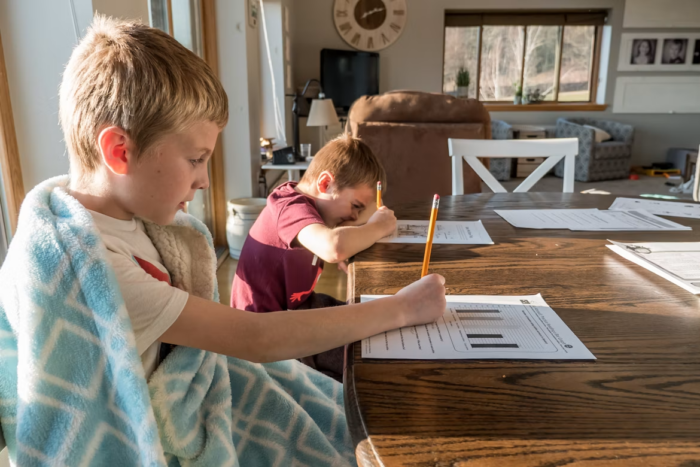
Homeschool days can go from magical to miserable in about 20 minutes.
One second your child is wide awake at their kitchen desk. Next thing you know, they’re glaring at the wall because of the worksheet.
Homeschooling is BIG… really big. There are now over 3.4 million homeschool students in the United States alone for the 2024-2025 school year. That means lots of families are navigating how to keep the lights on when motivation runs low.
Here’s the good news: it’s fixable. Fast.
In this guide, you’ll find:
- Why Homeschool Motivation Really Drops
- Creative Projects That Bring the Day Back to Life
- Small Swaps That Fix a Stale Routine
- Building Motivation That Actually Lasts
Why Homeschool Motivation Really Drops
Children are not lazy. They’re simply programmed to tune out if a task doesn’t suit them.
Studies have found that teaching methods are causing 49% of students to disengage from learning. When students aren’t engaged, it’s typically not them…it’s the format.
Worksheets and lectures contradict students’ natural learning tendencies. Consider also that children have attention spans of about 10-15 minutes. No wonder there is a dreaded afternoon crash.
The three biggest motivation killers in a homeschool day are:
- Format fatigue — doing the same type of task over and over
- Zero choice — kids feel like passengers, not participants
- Passive learning — reading and listening without ever doing
Environment matters as well. A kitchen table that serves as your breakfast table AND the craft table begins to feel more like a jail cell than classroom. With a little knowledge of what to look for, you can turn it around before the whole day spirals downhill.
Creative Projects That Bring the Day Back to Life
This is where most homeschool parents get their biggest wins.
If a lesson isn’t working, replace it with a project that stretches the same concepts through an entirely different window. Writing, art, storytelling, building — they exercise reading, comprehension, organization, and troubleshooting all in one.
Having your child make their very own picture book is great for weeks when you just can’t seem to think of ideas. It touches on grammar, sequencing, character development, and visual design all at once. New to teaching kids how to make their own book? How to write a children’s book is a great article that guides you through the process from start to finish.
Have them draft up some art notes for illustrators. These are the brief descriptions authors provide for what they want on each page of the book. Even if your child will be illustrating their own book, understanding how to write art notes for illustrators will force them to think visually and learn to concisely describe what they want.
Here’s why art notes for illustrators are so powerful for engagement:
- They combine writing and art in one task
- They give the child real creative control
- They make abstract stories feel tangible
- They finish with a project the child can actually hold
That last point is more important than most parents understand. Children will remain motivated when they can see the end nearing.
Picture books also distill a genuine creative process into something a child can complete in a matter of days. That feeling of accomplishment is massive for sustaining motivation throughout the entire semester.
Small Swaps That Fix a Stale Routine
Fixes don’t have to be projects. Occasionally 1 little thing puts the day back on track.
Switch up your scenery. Instead of doing math at the kitchen table, take it outside on the porch. Read a book on a picnic blanket. Do spelling at the local coffee shop on a whiteboard. The brain associates a new scene with a new way of thinking.
Divide the day into smaller chunks. Rather than one 45-minute block, schedule three 15-minute blocks with activity between. Student attentiveness plummets after just 20 minutes of consecutive lesson time — smaller chunks help maintain attentiveness.
Make everything hands-on. Learning about fractions? Bake. Studying weather? Make a rain gauge. History? Create a mini play. Hands-on activities trump reading 99% of the time.
Give them control over the order. Let your child decide whether they want to do maths before spelling or vice versa. That little bit of control goes a long way.
Throw in a “wild card” topic. Throw in something completely random one day a week. Astronomy, programming, cooking or comic-book art. Children stop fearing the inevitable when they know something fun is happening.
Building Motivation That Actually Lasts
Band-aids are nice, but the real win is creating a habit your child loves.
That means:
- Rotating subjects and formats week to week
- Building in “passion project” time where they choose what to study
- Keeping a running list of finished work so progress feels visible
- Ending each day on a high note, not a hard task
The happiest homeschool families are the ones who approach learning organically. When something’s not clicking, they don’t push through it – they change direction. Children learn from that. They learn that learning bends around them.
And when you make creative projects a regular part of your week, writing stories, drawing them, including art notes for artists to know what to draw, crafting little worlds on paper… motivation isn’t something you have to seek out. It becomes your norm.
The greatest thing about habits is that they snowball. Once a child completes their first picture book, they’re likely to want to read another…and another…building a series. That momentum is what will pull you through the difficult weeks when it feels like nothing else is clicking.
Remember, homeschool motivation is not a problem you fix once and for all. It’s a cadence you adjust as your child changes and their interests evolve.
The Bottom Line
Homeschool motivation dips are normal. What matters is how quickly you can reset.
Successful families don’t adhere to a single strategy—they blend maker time, pomodoros, and autonomy throughout the week. It’s this variety that prevents kids from tuning out.
To quickly recap:
- Motivation drops mostly because of format, not effort
- Picture books & Art Notes for Illustrators help restore energy QUICKLY
- Small switches – new environment, short cuts, manual labor – refresh a mundane day
- Long-term motivation comes from rhythm, choice, and visible progress
Do one of these tomorrow. You’ll be amazed at how fast a bad homeschool day becomes a good one.










Leave a Reply