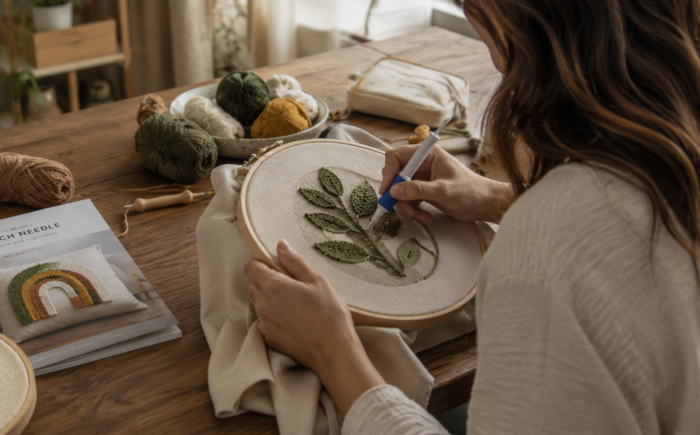
If you’ve spent any time on TikTok lately, you’ve probably seen someone punching yarn through fabric and making it look oddly satisfying. The #punchneedle hashtag had racked up nearly 2.5 billion views, which means this isn’t some niche revival – it’s a full-on mainstream moment. And honestly? There’s a reason busy moms keep showing up in that comment section saying “I need to try this.”
Punch needle is one of those crafts that sounds more complicated than it is. You don’t need a degree in fiber arts. You don’t need hours of uninterrupted time. And the finished pieces actually look like something you’d buy at a boutique, not something that ends up stuffed in a drawer.
This guide covers what punch needle embroidery actually is, why it works so well for people with limited time, what the research says about crafting and stress relief, and exactly what you need to get started.
What Is Punch Needle Embroidery, Exactly?
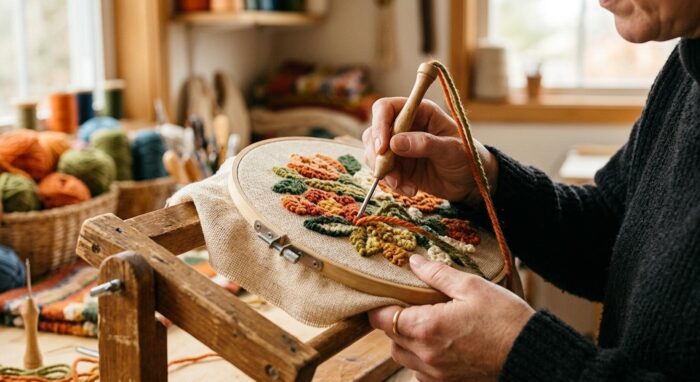
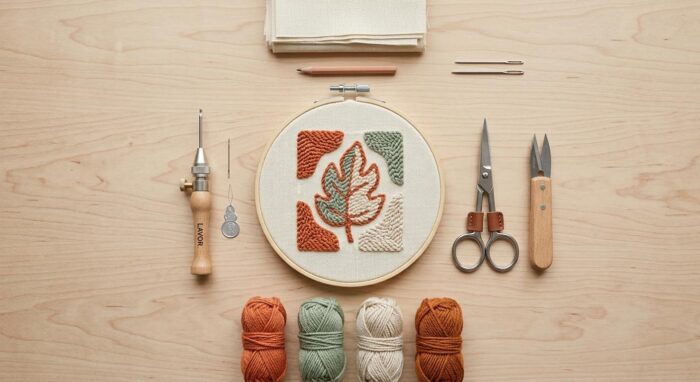
Punch needle embroidery is a textile craft where you use a hollow needle tool to push loops of yarn or thread through an open-weave fabric – usually monk’s cloth or weaver’s cloth – held taut in an embroidery hoop. Each “punch” creates a small raised loop on the front of the fabric. Work across a design, and those loops build into a thick, textured piece that looks almost like a rug or a plush wall hanging.
It’s faster than traditional embroidery because there’s no counting stitches, no knotting, and no threading a needle through from one side to the other. You just punch, move, punch, move. The technique goes back thousands of years – early versions of rug hooking date to ancient Egypt – but the modern punch needle revival is lighter weight, using smaller tools and softer yarn or embroidery floss for decorative pieces rather than full rugs.
Getting started is much easier than it used to be. A good punch needle embroidery kit comes with the tool, fabric, yarn or floss, a hoop, and often a beginner pattern, so you’re not hunting down five separate items from five different stores. You open the box and you’re ready to go.
Why Busy Moms Are Actually Loving This Craft
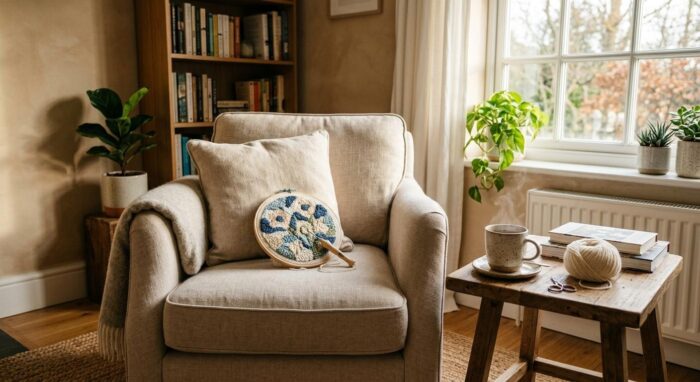
The biggest reason punch needle works for people with packed schedules: you can put it down mid-project and pick it back up three days later with zero penalty. There’s no counting to track. No row marker. No “where was I again?” moment of frustration. You just look at your hoop, find the edge of your last loop, and keep going.
Compare that to knitting or crochet. Both are wonderful, but if you lose count on a cable pattern or forget which row you were on, you can unravel real progress. Punch needle doesn’t punish you for setting it down. That makes it genuinely compatible with mom life, where “10 minutes here and there” is often the reality.
The results also come fast. Most beginners finish a small piece, whether it’s a coaster, an ornament, or a 4-inch wall hanging, in one or two short sessions. That quick payoff matters when you’re tired and need a win. It’s very different from spending three months on a cross-stitch sampler before you can see what it’s going to look like.
If you’re already thinking about adding a creative outlet to your routine, punch needle slots in naturally with other relaxing hobbies that don’t require a huge time commitment or a lot of gear.
The Stress-Relief Science Behind Repetitive Crafts
Here’s the thing: it’s not just anecdotal that crafting feels calming. The research on this has been building for years, and it’s pretty clear.
A 2024 scoping review published in Issues in Mental Health Nursing – titled “Healing Stitches” – mapped 25 studies on needlecraft and found an overwhelmingly positive effect on mental health across four themes: mental well-being, social connection, sense of purpose, and self-identity. That’s not a small sample of cherry-picked outcomes. That’s 25 studies pointing the same direction.
A 2025 systematic review in the Australian Occupational Therapy Journal went broader, examining 19 studies on craft-based interventions specifically. All 19 – every single one – reported short-term improvements in mental health outcomes including anxiety, stress, depression, and mood. Not most. All 19.
A 2024 study in Frontiers in Public Health pulled data from 7,182 adults across England and found that engagement in arts and crafts positively predicted subjective wellbeing. The sample size alone makes that finding hard to dismiss.
The reason repetitive crafts like punch needle seem to work so well is the rhythm. Repetitive hand movements – the same motion over and over – activate the parasympathetic nervous system, which is the “rest and digest” side of your nervous system. Your heart rate slows. Your focus narrows to the task in front of you. It’s not meditation, but it works a lot like it.
You don’t need to read a research paper to feel the difference. But it’s good to know the science isn’t just backing up a vibe.
What You Can Make (and Who Would Love It as a Gift)
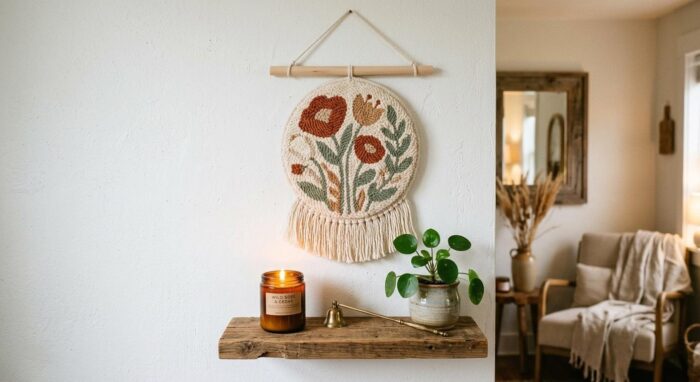
Small pieces are where most beginners start, and they’re also where the gift potential is obvious. A punch needle coaster set looks like something from an Etsy shop. A 6-inch wall hanging with a simple floral or botanical design reads as boutique home decor. A small tote bag with a punched design on the front is the kind of handmade gift people actually use.
Common beginner projects include:
- Wall hangings (the most popular starting point – easy to frame and display)
- Coasters (fast to make, practical, great in sets of four)
- Decorative pillows (slightly more advanced but very satisfying)
- Ornaments (perfect for holiday gifting)
- Tote bags (punch a design on a pre-made canvas tote)
- Phone cases (a newer trend, uses smaller punch needle tools)
The gift angle is real. Punch needle pieces have a handmade warmth that a store-bought item doesn’t, but they don’t look rough or amateurish the way some DIY gifts can. If you’re someone who loves making things for the people in your life, punch needle fits right alongside the other homemade gift ideas you’ll find on this site.
How to Get Started: What You Actually Need
You only need four things to start punch needle embroidery:
- A punch needle tool. These come in different sizes – smaller for embroidery floss and fine detail work, larger for bulky yarn and faster coverage. Most beginner kits include a medium-weight tool that handles standard worsted yarn well.
- Open-weave fabric. Monk’s cloth and weaver’s cloth are the go-to options. The open weave is essential because the needle needs to pass through the fabric cleanly. Don’t use linen, felt, or denim – the needle won’t punch correctly through those materials.
- An embroidery hoop. You need the fabric pulled drum-tight. A loose hoop means your loops will pull out as you work. Most projects use a 6-inch or 8-inch wooden hoop.
- Yarn or embroidery floss. For wall hangings and decorative pieces, worsted-weight acrylic yarn is affordable and easy to work with. For finer work, embroidery floss gives you more color options and sharper detail.
A starter kit bundles all of this together, which is why it’s usually the cheaper and easier entry point – especially if you’re not sure yet how much you’ll use it.
For your first design, keep it simple. A single floral, a geometric shape, or even a simple initial works better than a complex landscape. You want to get comfortable with the punching motion before you add design complexity.
Like making bath bombs at home, punch needle is a project you can set up in 20 minutes and genuinely enjoy all afternoon – low prep, high satisfaction.
Common Beginner Mistakes (and How to Avoid Them)
Most beginners run into the same handful of issues. Knowing them ahead of time saves real frustration:
- Loops falling out. This almost always means the fabric isn’t tight enough in the hoop. Pull it taut before you start – it should feel like a drum. Re-tighten every 15-20 minutes as you work, since monk’s cloth tends to stretch.
- Punching at the wrong angle. The needle should be perpendicular to the fabric at all times, not tilted. Tilting causes uneven loops and makes it harder to pull the needle back without dragging existing stitches.
- Pulling the needle too far out between stitches. After each punch, keep the tip of the needle touching – or just barely grazing – the fabric surface as you walk it to the next position. Lifting the needle too high breaks the previous loop.
- Using the wrong fabric. This is the one that trips up the most people. Linen, regular canvas, denim, or felt won’t work. The needle can’t pass through cleanly, and even if it does, the loops won’t hold. Monk’s cloth and weaver’s cloth are worth buying specifically.
- Skipping a backing. Once you’re done, the loops on the front of your piece need something to hold them in place. A fabric backing glued or sewn onto the underside keeps everything secure. Without it, the piece can unravel over time, especially if it’s a gift that’ll be handled often.
None of these are hard to fix once you know about them. Most beginners hit one or two of these on their first project and figure it out by their second.
A Hobby That Fits Into Real Life
Punch needle embroidery has a short learning curve, a fast payoff, and a flexibility that most crafts don’t offer. You don’t need experience. You don’t need a dedicated craft room. You need about $30, an hour, and a design you like. The fact that it also happens to be backed by real mental health research is a bonus – but honestly, the reason people keep coming back is simpler than that. It just feels good to make something with your hands.
If you’ve been looking for a hobby that actually fits into real life rather than requiring you to rebuild your schedule around it, this one’s worth trying.

Leave a Reply