
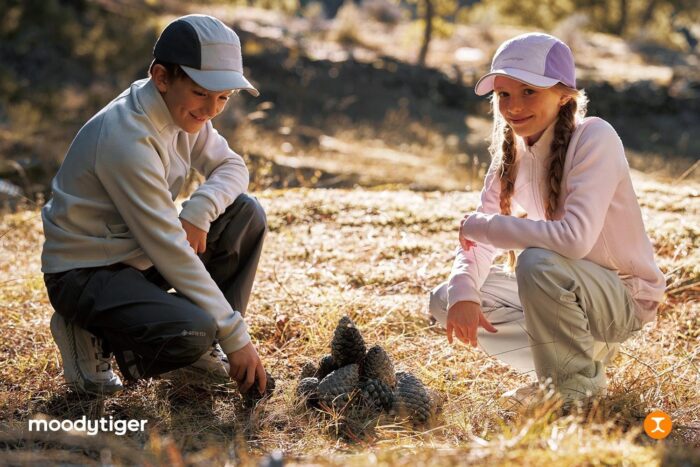
Last month, our family hiked two kilometers in a little over three hours. By any adult metric you’d care to name — pace, distance, elevation, ‘efficiency’ — it was an unmitigated disaster. By the only metrics that actually mattered to the seven-year-old setting the pace, it was an all-time classic, an outing still being cited weeks later. The itinerary, as best I can reconstruct it: forty uninterrupted minutes sorting pinecones by size and perceived quality, one beetle funeral attended with full and solemn honors, a stick collection so extensive it required delicate diplomatic negotiation at the trailhead, and — not incidentally — zero requests, across three hours, for a screen. I have paid good money for worse afternoons.
Somewhere along the way, without ever quite deciding to, family hiking picked up a pace problem. We march our kids from labeled viewpoint to labeled viewpoint as though childhood were a training block to be completed on schedule, then act genuinely puzzled when they start negotiating hard against the very next outing. But the children were never actually opposed to walking in the woods — the woods are, to a small person, close to paradise. What they were opposed to, sensibly, was our schedule for it. The forced march. The ‘come on, we’re nearly there.’ The destination we cared about and they didn’t.
So here is the single reframe that quietly rescued hiking in our house, and it’s almost embarrassingly simple: the hike is not the exercise. The stopping is the activity. The crouching over a patch of moss for a quarter of an hour is the activity. The woods themselves are the destination, which means — and this is the liberating part — you have already arrived, roughly ninety seconds from the car. There is nowhere further you actually need to get to. Everything after that is just how long you’re willing to stay in the good place. Reframe the goal from ‘cover the distance’ to ‘be out here,’ and the entire outing stops being a battle. ‘Stay in the play’ is how moodytiger frames its own design brief, and it happens to be the right test for any family outing too: the plan exists to keep the child out there, not the other way around.
Calibrate your expectations to the actual child in front of you, because age changes everything about what a ‘hike’ should be. A three- or four-year-old measures an outing in interesting objects, not distance — a few hundred meters punctuated by a hundred stops is a triumph, and turning back early is a success, not a failure. A five-to-seven-year-old can cover real ground if the terrain keeps offering things to do, but still runs on curiosity rather than willpower. It’s only around eight or nine that a kid can knowingly push through a dull stretch toward a goal, and even then the goal had better be good. Match the outing to that reality and everyone has a fine time; fight it, and you get the meltdown and the vow to never come again.
Slow hiking does, admittedly, change the wardrobe math in a way worth planning for. A briskly marching child generates plenty of their own heat and stays warm on movement alone. A crouching, kneeling, puddle-adjacent, moss-inspecting child does the opposite — they go cold and damp from the ground up, slowly, while fully absorbed and not noticing until they’re miserable. So you dress for the stopping, not the walking. A proper waterproof jacket for kids means that kneeling down in a patch of wet leaves to examine something is a free choice rather than a wet, cold consequence that ends the trip early. A warm mid-layer underneath covers the long, still pauses between the occasional bursts of running. And the trousers, realistically, are going to be sat in, slid down, and knelt on repeatedly — so plan for that, buy accordingly, and grieve absolutely nothing that comes home muddy.
It genuinely helps that outdoor gear for children has grown up over the last few years. The current generation of kids hiking clothes is finally cut for actual, observed child behavior — reinforced at the knees and seat where kids actually land and slide, cut with real stretch where they actually reach and scramble — rather than being adult trail gear simply photocopied down to a smaller size and sold with a cartoon on it. Brands like moodytiger design for the crouch and the scramble first, which turns out to be most of what real, honest kid-hiking actually consists of. Gear built for how children move, instead of how catalog adults pose, is gear that stays out of the way of the fun.
A small body of research quietly backs all of this up, for anyone who needs the permission. Unstructured time in nature — the aimless kind, not the guided-tour kind — is repeatedly linked to better attention, lower stress, and stronger problem-solving in children, and the effect seems to depend on exactly the thing that drives adults up the wall: letting them lead, letting them dawdle, letting them get absorbed in something pointless. The pinecone sorting isn’t a delay before the real activity. In developmental terms it may be the real activity, and the walking is just the incidental way you got there. You don’t have to hold that thought consciously on the trail; it just helps to know the slow version isn’t the lazy version. It’s the good version.
Our kit for these outings, refined over a full season of gloriously unproductive non-hikes, is short and hard-won. A cheap plastic magnifying glass that cost less than a coffee and has since delivered something like a thousand percent return on pure wonder. A paper bag for the day’s treasures, subject to a firm but fair customs inspection back at the trailhead. A thermos of something warm, held in reserve and deployed at the very first genuine sign of mutiny. And, as a standing rule, nothing that beeps, buzzes, tracks, or counts. The whole point is to be somewhere that none of those things reach.
A note on making it a habit rather than a one-off, because the magic compounds with repetition. Pick one loop close to home and do it again and again across the season — the same short trail in September, October, November — and something lovely happens: the kids start to notice the changes. The stream that was low is suddenly high. The green tunnel goes gold, then bare. The mud freezes. A familiar trail walked through a turning season teaches more about how the world actually works than a dozen scattered outings to impressive one-time destinations. Same path, different planet, every few weeks. Cheap, close, and quietly the best nature lesson going.
It’s worth naming the quiet gift underneath all this dawdling, because it’s easy to miss while you’re standing in the cold holding a stick you’ve been asked to hold. These slow, aimless, unhurried hours are how a child builds an actual relationship with a place — not a photographed visit to a famous view, but a genuine, weathered familiarity with a patch of ordinary woods that becomes, over a season of returns, theirs. That rootedness, the sense that there is a specific green place in the world they know and love, is something a lot of modern childhoods are quietly missing, and it can’t be rushed or scheduled into existence. It’s laid down slowly, one three-hour, two-kilometer non-hike at a time, and it lasts a lifetime.
A closing note, mostly for your own hard-won peace of mind. If, midway through your three-hour, two-kilometer expedition, another hiker powers cleanly past you on the trail — checking a watch, eating up the distance, doing the sport properly — just let them go with a smile. They are having a workout, and good for them. You are having something rarer and entirely unrepeatable: a childhood, experienced secondhand, one slow and muddy kilometer at a time, complete with a pinecone auction you did not authorize and cannot stop. There will be plenty of years for pace and distance and personal records later, should your kid ever want them. There are only a handful of years for this, for the beetle funerals and the named sticks. You will cover almost no distance at all. You will remember, I promise, very nearly all of it.







Leave a Reply