
Anytime a doctor mentions that you need to have an MRI, it may start with worrying about how this test will turn out, and a lot of people imagine a loud machine or a long time lying flat. However, the reality is that an MRI scan is safe, and it is not as scary as it might appear. MRI assists the doctor in providing a detailed image of the internal organs of your body. In this blog, we’ll explain what an MRI is, why doctors use it and what happens during the scan.
What is an MRI?
MRI stands for Magnetic Resonance Imaging, which is a type of medical scan that doctors use to see detailed imaging of body organs. As compared with X-rays or CT scans, MRI does not pose any radiation. Instead, it creates a strong magnetic field and radio waves to create accurate organ imaging.
MRI is highly useful in scanning soft tissues of the brain, spinal cord, muscles, ligaments and other internal organs. The scan itself is safe, painless and non-invasive, and you won’t feel any discomfort during the test.
How Does an MRI Work?
If you are searching for ‘MRI scan near me‘, first, you have to understand how this machine works to better prepare for it. An MRI machine functions by generating a powerful magnetic field, radio waves and a computer to generate clear images of your body.
The magnetic field in the scanner has short-term effects on the water molecules in your body when you lie there. Radio waves are then directed in, and once the molecules are returned to their usual state, they emit certain signals. These signals are picked up by the machines, and a computer transforms them into clear images of the vital organs.
Why are MRI Scans Done?
Doctors may order an MRI scan to get more details about your health conditions. MRI’s ability to show soft tissue in detail makes it one of the best tools for detecting subtle changes before they become a severe health concern. In this regard, some of the common MRI scan Hyderabad available are as follows:
- Brain and nervous system: MRI can be used in case you are experiencing headaches, dizziness, seizures, or any irregularities in memory. It provides detailed images of the brain and spinal cord, so that the doctor is able to identify a tumour, multiple sclerosis or stroke damage. With such images, you can locate the specific cause of your symptoms.
- Spine: Back and joint pain are frequent, but their reasons can vary. Through MRI, physicians are able to identify herniated discs, tears of the ligaments and cartilage damage. This kind of detail allows them to make the decision whether you require medication, physical therapy or surgery rather than making a decision based on guessing.
- Abdomen and pelvis: MRI scans are commonly performed to examine the liver, kidneys, uterus, prostate and others. They are able to identify infections, tumours or other changes which could be the cause of the current symptoms.
What Can You Expect During an MRI Scan
An MRI scan typically involves three stages: before the scan, during the scan, and after the scan. Here is each of them mentioned one by one:
Before the Scan
The first thing that the staff will do when you come in to have your MRI is to inquire about your medical history and any implants or devices that you may have. The machine has a strong magnet, so it is mandatory to keep away from metal items.
You might have to switch to wearing a hospital gown to ensure that clothing zippers, buttons, or jewellery do not interfere. In some cases, contrast dye may be necessary, which will typically be administered as a small injection in your arm before the scan.
During the Scan
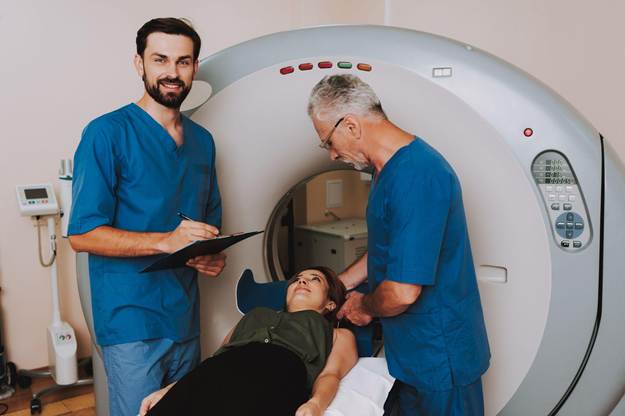
You will be lying on a narrow table that will slide under the MRI scanner, which resembles an oversized tunnel. Depending on which part of your body is under examination, only that part can be taken into the machine, but in some cases, your whole body can be taken in.
As soon as the scan begins, you will hear loud knocking or tapping sounds due to the magnets, and this is completely normal. In some situations, earplugs will be provided to make the scan easier. It is quite essential to remain as stationary as possible to get clear images of organs.
After the Scan
The scan is painless, and you won’t feel the magnet or radio waves. Most scans take about 15 minutes to an hour, and it also depends on the body part being scanned. Once the test is completed, you can get back to your home and be ready to do daily activities. However, if contrast dye was used during the test, it will naturally diminish within a few days.
What is Contrast Dye in MRI?
The dye is most commonly prepared using a substance referred to as gadolinium, which is frequently injected into the vein of your arm in a small dosage. After this dye gets into your blood, it helps to highlight specific tissues, blood vessels or uncertain areas. It is commonly applied when physicians require examining tumours, inflammation, blood vessel issues or minor issues observed in organs.
Conclusion
MRI scans are used to get a detailed image of the vital organs of the human body. It is highly useful in scanning soft tissues of the brain, spinal cord, muscles, ligaments and other parts of the body. The scan itself can take about 15 – 20 minutes, but the overall process may take up to one hour or more because of the preparation of the test. This test is non-invasive and you won’t feel discomfort during the test.
Well, if you are looking for a reliable solution to get your MRI scan, then you can choose Vijaya Diagnostic Centre. They have highly qualified and experienced radiologists to examine MRI scan results and they also have the desired certification.










Leave a Reply