Can we be real for a minute? Parenting is one long exercise in hoping nothing goes wrong while quietly bracing for the moment it does. You babyproof the outlets. You cut the grapes in half. You hover at the playground. But there’s one just-in-case skill that so many of us never get around to, and it’s the one that matters most when a scary moment actually arrives. Getting your CPR certification is one afternoon that can change how you handle the worst day of your parenting life.
I know, I know. Between school drop-offs, the dinner scramble, and the laundry that breeds overnight, who has time? But stick with me. This isn’t a lecture. It’s the thing I wish someone had nudged me to do years ago.
Why Does Child First Aid Feel So Different?
Here’s the thing nobody tells you. First aid for little ones isn’t just adult first aid in a smaller size. Kids’ bodies respond differently. Their airways are tinier. They go downhill faster, and they bounce back faster too, if you act right.
That’s exactly why a course built around children is worth it. You learn how to respond to a baby versus a bigger kid, because what works for one isn’t the same for the other. And once you know the difference, that low hum of worry in the back of your mind gets a lot quieter. Confidence replaces panic. That’s the whole gift.
What Should I Do If My Child Is Choking?
Oh, this one. If you’ve ever watched your toddler go suddenly silent with a chunk of apple in their mouth, you know the specific terror. Choking is fast and it’s quiet, which is what makes it so frightening.
The response depends on the age, and this is one of the clearest reasons to take a hands-on class.
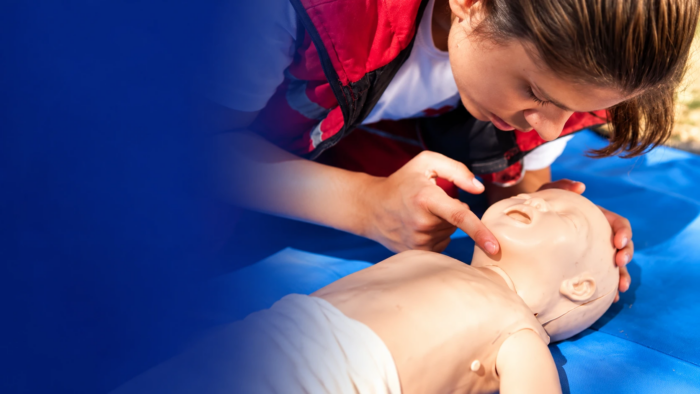
For a baby under one, you’d support them face-down along your forearm and give firm back blows between the shoulder blades, then flip and give chest thrusts. It’s a specific motion, and practising it on a mannequin until it feels natural makes all the difference.
For an older child, the technique shifts to abdominal thrusts, adjusted for their size.
Reading those words is one thing. Doing the movement with an instructor guiding your hands is another entirely. That muscle memory is what shows up for you when your brain goes blank with fear.
Could I Really Perform CPR on My Own Child?
It’s the question no parent wants to sit with. But think about it this way. If your child’s heart stopped, wouldn’t you want to know you could do something other than wait helplessly for the ambulance?
In Canada, roughly 60,000 cardiac arrests happen outside hospitals every year, and only about 1 in 10 people survive. Fast action tips those odds. Starting CPR right away and, where one is available, using an AED can double someone’s chance of making it.
Child CPR follows the same core idea as adult CPR, scaled down. You push on the centre of the chest, hard and fast, about 100 to 120 times a minute, letting the chest rise fully between each push. A course teaches you the right depth and hand position for a child versus an infant, because those details matter when the body is small. And a good class, like one that offers CPR/AED Level C, covers adults, children, and infants all together, so you’re ready for your whole family.
How Do I Handle Allergic Reactions and Fevers?
If you’ve got a kid, you’ve googled “is this fever too high” at 2 a.m. at least once. You’re not alone. Knowing what to watch for takes a lot of the guesswork out of those middle-of-the-night moments.
With allergic reactions, the skill is recognizing when something’s gone from annoying to serious. Hives and a bit of sniffling are one thing. Swelling of the face or lips, trouble breathing, or a child suddenly going pale and floppy is a whole different level that needs emergency help right away. A course helps you tell the difference and act without second-guessing yourself.
Fevers are the same story. Most are your child’s body doing its job, fighting something off. But training helps you spot the warning signs that mean it’s time to get help rather than ride it out at home. I’m not talking about diagnosing or dosing anything, just knowing when “keep an eye on it” becomes “call now.” That clarity is honestly worth the class on its own.
What About Everyday Kitchen Scrapes and Burns?
This is where first aid earns its keep day to day. The dramatic emergencies are rare, thank goodness. But the little stuff? That’s a Tuesday.
A kid grabs a pot handle. Someone slices a finger “helping” with dinner. A scraped knee from the driveway. Knowing the basics keeps these from becoming bigger problems and keeps you calm while your little one is howling.
- Minor burns: cool the area under cool running water for several minutes. Skip the butter and the ice, which can make things worse.
- Small cuts: clean it gently and apply steady pressure to stop the bleeding.
- Bumps and scrapes: clean, cover, and comfort, usually in that order.
None of this is complicated. But knowing it cold, instead of frantically searching your phone with one hand while holding a crying kid with the other, is a different kind of parenting peace.
Is One Afternoon Really Worth It?
Let me put it in mom terms. We spend an afternoon at soccer practice, an afternoon at a birthday party, an afternoon just getting through Costco. One afternoon to learn how to save your child’s life? That’s not a big ask. That’s maybe the best-spent afternoon of the year.
And the format makes it genuinely doable for busy families. A lot of courses now use blended learning, where you knock out the theory online whenever you get a quiet moment, then come in for one short in-person session to practise the hands-on parts. Nap time, after bedtime, in the pickup line. The online piece fits into the cracks of your day.
Here’s the truth that keeps me recommending this to every parent I know. The skills don’t just protect your own kids. They make you the person other parents are grateful for at the playground, the birthday party, the family barbecue. You become the calm one. The ready one. When you’re ready to take the plunge, finding Coast2Coast First Aid near you is the easy first step, and future-you will be so glad you did.
Because the goal isn’t to live in fear. It’s the opposite. It’s to trade that background anxiety for quiet confidence, knowing that if the worst ever happens, your hands will know what to do.
How Do I Keep My Home Ready Without Going Overboard?
You don’t need to turn your house into a mini hospital. A few simple habits go a long way, and they fit right into the organized chaos of family life.
Start with a real first aid kit, not the sad little box with three old bandages rattling around in it. Keep one stocked in the kitchen and a smaller one in the car. Bandages, gauze, gloves, and a way to cool a burn cover most everyday scrapes. Check it a couple of times a year, maybe when you flip the clocks, so it’s never empty when you reach for it.
Next, write down the important numbers and info somewhere everyone can find it. Your address spelled out for a flustered babysitter, any allergies your kids have, your doctor’s number. In a panic, even grown-ups forget their own street. A little card on the fridge takes the guesswork out.
Then make sure the other adults in your kids’ lives are on the same page. Grandparents, your partner, the regular sitter. The more of them who know the basics and know your plan, the safer your little ones are no matter who’s watching them.
What If I Put It Off and Nothing Ever Happens?
Honestly? That’s the best-case scenario, and I hope that’s your story. But here’s how I’ve come to think about it. First aid is like a car seat or a smoke detector. You hope you never test it the hard way. You buckle up and change the batteries anyway, because the one time you need it, nothing else matters.
Learning these skills isn’t about expecting tragedy. It’s about loving your kids enough to be ready for the small chance you’ll need to protect them. And if that day never comes, you’ve lost nothing but one afternoon. If it does come, you’ll have gained everything. For a busy parent, that’s about the best trade there is.
If you’re looking for child-focused first aid and CPR training in the Saskatoon area and surrounding communities, you may reach out to Coast2Coast First Aid & Aquatics in that area.
Frequently Asked Questions
Q: My kids are past the baby stage. Is this still worth it?
A: Definitely. Older kids still choke, get hurt, and have emergencies, and the techniques for a bigger child are different from those for a baby. A good course covers every age, so you’re ready whether your child is two or twelve.
Q: I’m squeamish and not a “medical” person. Can I still do this?
A: Absolutely. These courses are built for everyday parents, not nurses. Instructors assume you’re starting from scratch and walk you through everything gently, one step at a time.
Q: Do I have to practise on a real baby?
A: No. You practise on special training mannequins, both infant and child sizes. That lets you build the muscle memory for things like back blows and compressions safely, without any pressure.
Q: How long does certification last?
A: Most first aid and CPR certifications are good for three years. A short refresher afterward keeps your skills sharp, which is reassuring as your kids grow and your family changes.
Q: Can my partner or our babysitter take it too?
A: Yes, and it’s a wonderful idea. The more caregivers in your child’s life who know these skills, the safer your little ones are, whether they’re with you, a grandparent, or a sitter.






Leave a Reply